
Cool Down Stretches After a Workout: A Simple Routine for Every Fitness Level

A cool-down is a gentle transition, not a guaranteed cure for soreness. Choosing cool down stretches after workout can feel confusing when you’re unsure which muscles to focus on, how long to hold a position or how strong the stretch should feel. You don’t need a complicated routine to wind down safely.
If you’ve wondered whether skipping stretches will leave you stiff or slow your recovery, you’re not alone. Stretching can support flexibility and provide a calm finish, but it shouldn’t be relied on to prevent soreness. The American Heart Association recommends allowing 5 to 10 minutes to cool down after exercise so your body can return to its usual pace gradually.
This guide gives you a flexible routine for different fitness levels, with options based on the muscles you’ve used. You’ll learn how long to hold each stretch, what a comfortable stretch feels like and when to stop. We’ll also explain what stretching can and can’t do for recovery, so you can finish your workout with confidence.
Table of Contents
Why cool down stretches after a workout can help you wind down
Your cool-down doesn’t need to be long or complicated. After a brisk run, strength session or fitness class, spend a few minutes moving at an easier pace, then let your breathing settle. You can add comfortable stretches for muscles that feel tight. Choose what suits your workout and how you feel that day, rather than trying to copy a routine that doesn’t fit.
What happens during a post-workout cool-down?
A cool-down is a gradual transition from exercise to a more relaxed pace. Rather than stopping suddenly after working hard, ease your effort with light movement, such as walking slowly after a run. Give your breathing time to settle. If it feels comfortable, add still, held stretches for muscles that feel tight. These are related parts of winding down, but they aren’t interchangeable. The overview of Cooling down also describes stretching as one possible part of the process.
The American Heart Association recommends a 5 to 10-minute cool-down after exercise. You can use that time flexibly:
Light movement gradually lowers your effort. Walk, pedal gently or move around at an easy pace.
Steady breathing gives you a moment to relax. Breathe comfortably, without forcing deep breaths or holding them.
Stretching lets you gently lengthen a muscle while staying still. It can feel calming, but it isn’t a substitute for easing out of intense activity.
Do you need to stretch after every workout?
No single stretching routine is essential after every session. Tailor your cool-down to what you’ve done: after a hard run, walking slowly may be enough to start; after lifting, you might prefer a few gentle stretches for the areas you trained. If stretching feels uncomfortable, skip it or use a smaller range of motion. You don’t need to force a position or stretch every muscle.
Stretching may feel relaxing and can support flexibility over time, but don’t count on it to prevent delayed-onset muscle soreness, the tenderness that can appear after exercise. Soreness can still occur whether you stretch or not. A useful cool-down is about finishing at a manageable pace, not guaranteeing how your body will feel tomorrow.
Keep it simple: reduce your effort first, take a moment to breathe, then stretch only if it feels good. The best cool down stretches after workout are comfortable for your body and practical enough to repeat. In the next sections, you’ll see how to match your stretch choices to the muscles you’ve used.
How cool-down stretches work with the muscles you have trained
Once you’ve eased your effort, choose a few stretches for the areas that worked hardest. A static stretch means moving into a position and holding it still, rather than repeatedly moving in and out of the stretch. Moving stretches involve controlled motion through a comfortable range. They have different roles: moving stretches are commonly used to prepare for activity, whilst static holds can be included after your workout.
There’s no need to stretch every muscle equally. Think about the session, then choose one or two areas that feel as though they’d benefit from a gentle stretch. The American Heart Association’s cool-down guidance also supports easing your body out of exercise gradually. For static stretches, ACSM flexibility guidance suggests most adults hold each position for 10 to 30 seconds and repeat it two to four times. Keep the sensation comfortable, not painful.
Which muscles should you stretch after leg day or cardio?
Match your stretches to the work you’ve done. After running or cycling, you might focus on your calves and hamstrings; after squats or lunges, your quadriceps and hips may feel more involved. You don’t have to stretch all of them. Try one at a time, and adjust or stop if you feel pain, pinching or unsteadiness.
Quadriceps: Stand near a wall or sturdy support and hold it for balance. Bend one knee and bring your heel gently towards your seat. Keep your knees close and your back comfortable. You should feel a light stretch at the front of your thigh.
Calves: Face a wall and place your hands against it. Step one foot back, keep that heel down and bend the front knee slightly. A mild stretch in the back calf is enough. Move your back foot closer if the stretch feels too strong.
Hamstrings: Sit near the front of a chair and extend one leg with the heel on the floor. Keep your back long and hinge forwards a little from your hips until you feel a gentle pull at the back of your thigh.
Which stretches suit an upper-body workout?
After an upper-body session, choose positions that feel natural for your chest, shoulders or back. Move slowly and stay within a range you can control. You don’t need to pull your shoulders into a deep stretch to make the position useful.
Chest: Stand beside a doorway, rest your forearm lightly against the frame and turn your body away a small amount. Keep the shoulder relaxed.
Shoulders: Bring one arm across your chest and use the other hand to guide it gently closer. Don’t pull at the elbow or lift your shoulder towards your ear.
Upper back: Sit or stand, reach both hands forwards and gently round your upper back as you breathe out. Let your shoulder blades move apart without forcing the position.
Comfort and mobility vary, so use a smaller range or skip any stretch that doesn’t suit you. For individual movement guidance, personal training at Gym n Go Forest Hill can help you build confidence with exercise choices and technique.
Static stretching after exercise: what it can and cannot do
Static stretching and gentle movement can both fit into a cool-down, but they serve different purposes. An easy walk keeps you moving at a lower intensity, whilst a static stretch involves holding a position without bouncing. Use either option, or combine them, depending on your workout and what feels comfortable.
Should you stretch or keep moving after a workout?
Let the session guide you. After cardio, a short, easy walk may be a natural way to reduce your pace. After strength training, you might prefer to move gently before stretching a muscle group you’ve worked. There’s no single format that suits everyone. If stretching feels awkward, stick with easy movement; if you feel settled, add a comfortable hold. Keep both options controlled.
A mild pulling sensation in the muscle being stretched can be normal. It shouldn’t feel sharp or painful. Ease out of the position if you notice pain, tingling, numbness or discomfort inside a joint. Don’t push through these signals or assume a deeper stretch is more effective. Your range of motion can vary from day to day, so adjust the position to suit how you feel.
Can cool-down stretches stop muscle soreness?
Stretching can feel relaxing, but it shouldn’t be presented as a reliable way to prevent or remove delayed-onset muscle soreness (DOMS). A 2025 meta-analysis of 15 studies found no statistically significant effect of post-exercise stretching on soreness, strength, performance or flexibility. That doesn’t mean everyone feels the same after stretching; it means a soothing sensation isn’t proof that soreness or recovery has changed.
Think of comfort and recovery as separate outcomes. You may enjoy how a stretch feels and still experience muscle tenderness later. A cool-down can be a useful way to finish exercise, but it can’t guarantee how your body responds. The best cool down stretches after workout are gentle, optional and chosen for how they feel, not as insurance against soreness.
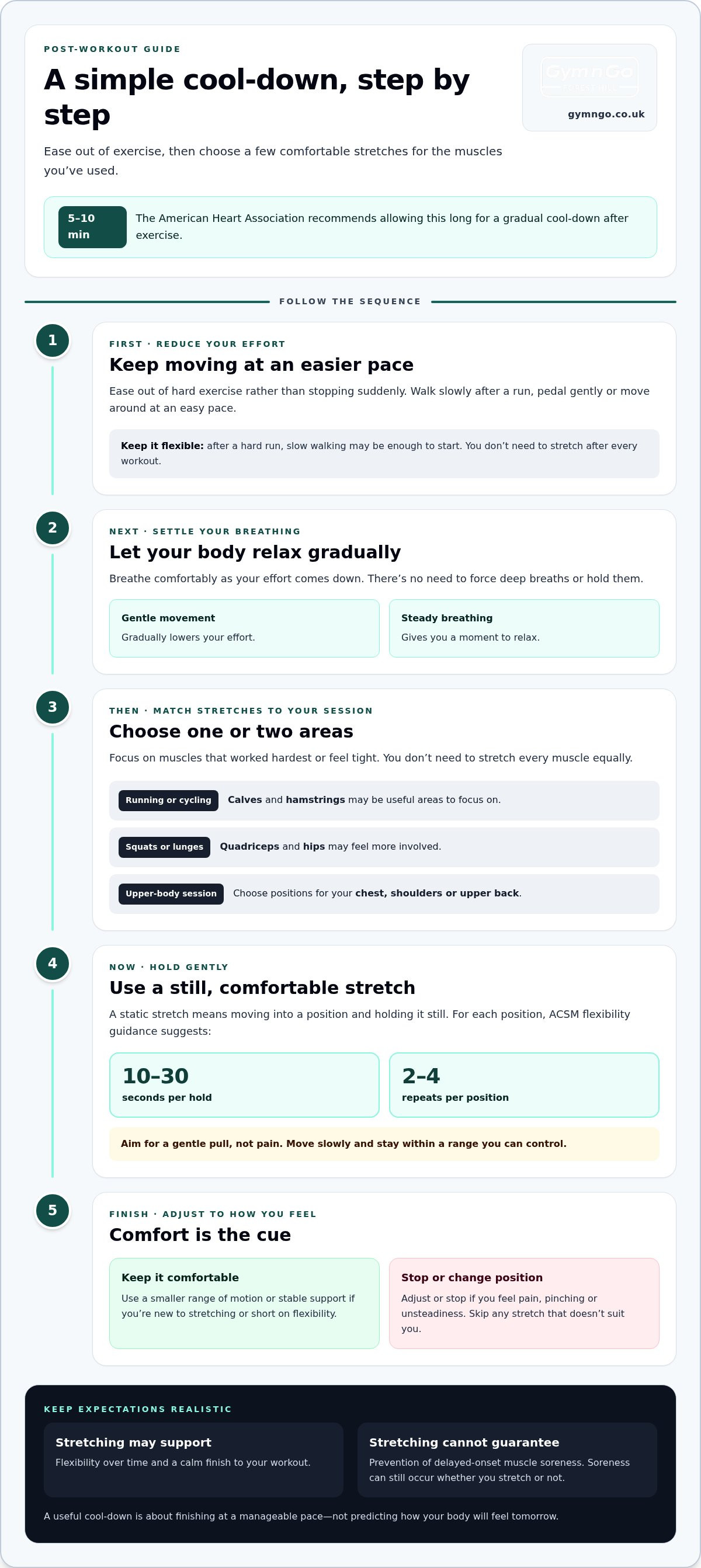
A simple cool-down stretching routine to follow after your workout
Use this routine as a flexible template, not a checklist you must complete. Start by reducing your effort, then choose stretches for the areas you trained. A short sequence of cool down stretches after workout can suit a run, weights session or class. Leave out any position that doesn’t feel right for you.
How to do a gentle post-workout stretch sequence
Move slowly between positions. Keep your shoulders loose and breathe normally, easing into each stretch as you breathe out. Start with easy movement, then choose a few options below that match your session.
Walk or move gently. Walk at an easy pace, or pedal slowly if you’re on a bike. Let your effort settle before you stop.
Stretch your calves. Face a wall for support and step one foot back. Keep its heel on the floor, bend your front knee slightly and breathe steadily. Look for a mild stretch in the back calf.
Stretch your quadriceps. Hold a stable support, bend one knee and bring your heel gently towards your seat. Keep your knees close and your body relaxed. Stop at a light pull in the front of your thigh.
Stretch your hamstrings. Sit on a chair, extend one leg with the heel down, then lean forwards slightly from your hips. Keep breathing and aim for gentle tension at the back of your thigh.
Open your chest or shoulders. For your chest, rest a forearm lightly on a doorway and turn away a little. For your shoulder, guide one arm across your chest without pulling hard.
Relax your upper back. Sit or stand, reach your hands forwards and gently round your upper back. Breathe out as your shoulder blades move apart.
After a lower-body session, choose the calf, quadriceps and hamstring stretches. After upper-body training, try the chest, shoulder and upper-back options instead. You don’t need to cover every area.
How long should you hold each stretch?
ACSM flexibility guidance suggests most adults hold a stretch for 10 to 30 seconds, repeating it two to four times if comfortable. Treat this as general guidance, not a target you have to reach. Start with a shorter hold if you’re new to stretching, and come out of the position if it becomes painful, uncomfortable or difficult to breathe through. Shorten or skip any stretch that doesn’t feel right for you.
Make the routine your own. A few suitable stretches are a better fit than forcing your body through every step. If you’d like help building confidence with exercise technique and movement choices, explore personal training at Gym n Go.
Make your cool-down routine feel comfortable and sustainable
A cool-down is more useful as part of your routine when it feels manageable. You don’t need to be naturally flexible or spend a long time stretching after every session. Use a smaller range of motion, breathe steadily and choose positions that feel comfortable for your body. The aim is to finish calmly, not to force progress.
How can beginners adapt post-workout stretches?
Start with support. Hold a wall or sturdy chair for balance during a standing stretch, or choose a seated option if standing feels difficult. Move only as far as feels comfortable; flexibility varies between people and from day to day. There’s no need to push deeper or compare your range with someone else’s. For individual exercise guidance, explore personal training in Forest Hill.
If you’re short on time, keep the sequence brief. Walk gently for a little while, then choose one or two stretches for the muscles you’ve used. If a position feels awkward, leave it out or try an easier version. A short, comfortable cool-down is more sustainable than a longer routine you dread or feel you have to complete perfectly.
Pay attention to how your body responds. Mild tension in the muscle can be part of a stretch, but stop if you feel sharp pain, numbness, tingling or an unusual sensation. Don’t stretch through it. If symptoms persist, return or concern you, seek appropriate clinical advice. You can also skip any movement that doesn’t feel suitable and use gentle movement instead.
How can you make cooling down part of your routine?
Attach your cool-down to something you already do. After your final set, walk back slowly; after a run, ease your pace before stopping. Choose a familiar stretch or two and treat them as a calm finish, not another test. Classes such as yoga in Forest Hill can also sit alongside other forms of movement in a balanced routine, without replacing your own post-workout choices.
Keep adjusting. On a rushed day, a few minutes of gentle movement may be enough; when you have more time, add stretches that feel comfortable. The best cool down stretches after workout are ones you can adapt to your session and return to without pressure.
Gym n Go Forest Hill offers a welcoming setting for building confidence in your exercise routine. If individual movement guidance would be helpful, personal training is one option.
Make your next workout finish well
Let your cool-down become a small, steady habit rather than another fitness target to chase. Choose cool down stretches after workout that feel comfortable today, and adapt them as your session or energy changes. A relaxed finish can be one simple way to make exercise feel more balanced and sustainable.
If you’d value personal guidance, Gym n Go Forest Hill offers one-to-one personal training, alongside yoga and Pilates classes. These can help you explore movement as part of your wider routine, at a pace that feels right for you.
Explore flexible gym membership, personal training and classes at Gym n Go Forest Hill, and find a supportive next step for your fitness journey. Keep it simple, stay comfortable and take each workout one finish at a time.
Frequently Asked Questions
Is it good to stretch straight after a workout?
Yes, cool down stretches after workout sessions can be useful if they feel comfortable, but first move away from intense effort. After treadmill intervals, for example, walk at an easy pace before stopping to stretch. Then choose a position for a muscle you’ve worked, such as your thighs after squats. Keep the range gentle and breathe normally. You don’t need to stretch simply because a workout has ended.
How long should you hold a cool-down stretch after exercise?
There isn’t one ideal hold for every person, though ACSM guidance suggests 10 to 30 seconds for most adults. Treat that as a guide, not a challenge. You might begin with a shorter hold and build only if it remains comfortable. Keep breathing rather than counting through strain. If the stretch becomes painful, causes tingling or feels wrong for your body, release it and choose another position.
Can stretching after a workout prevent muscle soreness?
No, stretching can’t be relied on to prevent or remove post-exercise soreness. You might feel calmer or more comfortable after a gentle stretch, but that sensation doesn’t guarantee a different recovery response. Avoid stretching harder in the hope of stopping tenderness later. If soreness feels severe, is unusual for you or isn’t improving as expected, pause strenuous activity and seek advice from an appropriate health professional.
Should you stretch before or after a workout?
Before exercising, choose movements that prepare you for the activity; afterwards, consider comfortable static stretches. Before a run, for example, start with easy walking and gradually build towards your running pace. If your session involves explosive strength or power, avoid relying on long static holds immediately beforehand, as they may temporarily affect performance. Match your preparation and finish to the demands of the session and follow qualified guidance.
What should a cool-down feel like?
A cool-down should feel easier than your workout, not like another challenge. Your breathing should remain steady, and you should feel in control of each movement. A stretch may create mild tension in the muscle, but sharp pain, pins and needles or discomfort in a joint are signs to ease out. Try a smaller movement or leave that stretch out. There’s no benefit in forcing a position that doesn’t suit you.
Do you need to cool down after a short workout?
A short, gentle session may call for only a brief transition, rather than a full stretching sequence. If you’ve done a few light exercises at home, finish by moving at an easy pace and notice how you feel before stopping. After a short but intense effort, take more time to reduce your pace gradually. Let the activity and your own response guide you, rather than completing a fixed checklist.
Can you stretch after a workout if you are a beginner?
Yes, beginners can stretch after exercise by choosing simple movements and a range that feels manageable. Sit on a chair for a hamstring stretch, or keep one hand on a wall during a standing stretch if balance feels uncertain. Flexibility differs from person to person, so there’s no need to match someone else’s position. If you’re in Forest Hill SE23 and want individual exercise guidance, Gym n Go offers personal training.
Comments