
Yoga for Strength Training: How to Build a More Resilient Body in 2026

What if the secret to hitting your next personal best isn't adding more plates to the bar, but stepping onto a yoga mat instead? Integrating yoga for strength training into your weekly routine is a clever way to ensure your body remains resilient and ready for any challenge. Many of us have felt that stubborn tightness in our legs after a heavy session or struggled with a restricted range of motion during an overhead press. It's natural to feel a bit of hesitation during heavy sets when your muscles don't feel quite as mobile as they should.
We believe that everyone deserves to feel confident and capable in the gym. By combining the stability of weightlifting with the flexibility of yoga, you can unlock greater power and significantly improve your recovery times. This approach doesn't just help you lift heavier; it helps you lift better. In this article, we'll explore how to refine your technique and prevent injuries by creating a more balanced physique. You'll learn how to blend these two worlds to build a body that feels as good as it looks, ensuring you stay active and pain-free for the long term. Stronger. More mobile. Resilient.
Table of Contents
What is Yoga for Strength Training and Why Does It Matter?
Yoga for strength training isn't about replacing your barbell with a mat. It's a functional mobility practice designed to support your structural integrity. While traditional yoga often focuses on flexibility, this specific approach prioritises building a body that is both supple and stable under heavy loads. Think of it as a structural reset for the modern Forest Hill professional. After a day spent hunched over a laptop in SE23, your body needs more than just rest; it needs to be organised for the gym floor.
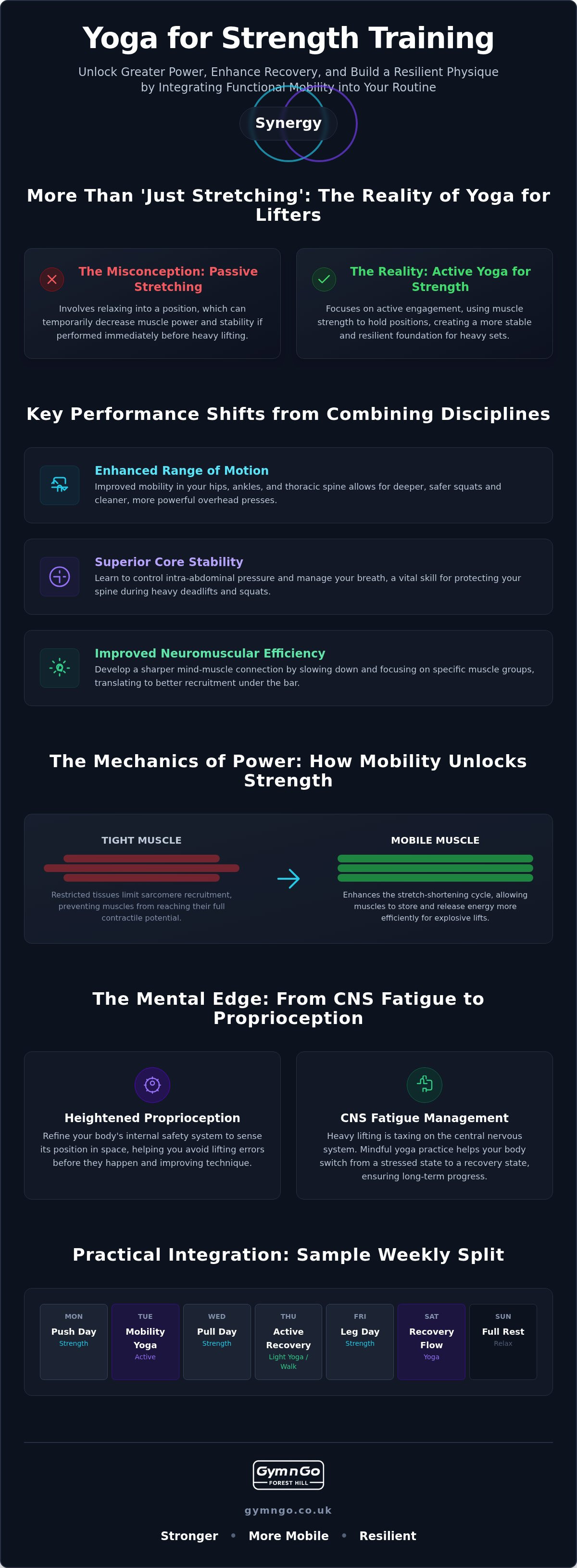
It's important to distinguish between passive stretching and active yoga. Passive stretching involves relaxing into a position. This can actually temporarily decrease muscle power if done right before lifting. In contrast, the yoga we practise at Gym n Go Forest Hill focuses on active engagement. You are holding positions using muscle strength, which creates a more resilient foundation for your heavy sets. The goal is to build a physique that moves with ease but remains rock-solid when you're under the bar.
The Core Benefits: More Than Just Flexibility
Integrating these movements into your routine offers advantages that go far beyond touching your toes. When you commit to yoga for strength training, you'll notice several key shifts in your performance:
Enhanced range of motion. Improved mobility in your hips and ankles allows for deeper, safer squats and cleaner overhead presses.
Intra-abdominal pressure control. Yoga teaches you to manage your breath and core stability, which is vital for protecting your spine during a deadlift.
Neuromuscular efficiency. By slowing down and focusing on specific muscle groups, you develop a sharper mind-muscle connection. This translates to better recruitment when you're back on the lifting platform.
Why Strength Athletes in SE23 are Turning to the Mat
Many of our members at Sunderland Road balance demanding careers with intense training. This lifestyle often leads to a desk-bound posture, where tight hip flexors and rounded shoulders ruin your lifting form. Yoga acts as the perfect antidote. It addresses these local imbalances, significantly reducing the risk of injury during heavy sessions.
Beyond the physical, yoga plays a key role in managing central nervous system (CNS) fatigue. Heavy lifting is taxing on the brain and nerves. The mindful, controlled nature of a yoga session helps your body switch from a stressed state to a recovery state. This means you can return to your next session feeling refreshed rather than drained. It's a smart way to ensure your fitness journey remains sustainable for the long term.
The Mechanics of Mobility: How Yoga Enhances Muscle Power
A tight muscle is often a weak muscle. This happens because restricted tissues limit sarcomere recruitment, preventing your muscles from reaching their full contractile potential. When you integrate yoga for strength training, you're giving your fibres the space they need to work at their best. It also enhances the stretch-shortening cycle. By improving your eccentric control during yoga poses, you develop the ability to store and release energy more efficiently during explosive movements like the squat or overhead press.
Hip and thoracic mobility are equally vital for compound lifts. If your upper back is stiff, your shoulders often take the brunt during a bench press. If your hips are locked, your lower back usually compensates during a deadlift. Proprioception is your body's ability to sense its position and movement in space; it acts as an internal safety system that helps you avoid lifting fails before they happen.
Unlocking Force Production Through Range of Motion
Better ankle mobility is a game-changer for your leg drive. When your ankles move freely, you can maintain a more upright torso and drive through the floor more effectively. This is particularly helpful for fixing 'butt wink', a common squatting error where the pelvis tucks under at the bottom of the movement. By opening the hips and ankles through regular practice, you ensure your spine stays neutral under load.
Shoulder health is another major win for regular lifters. A mobile thoracic spine allows the shoulder blades to move correctly, which is the key to bench press longevity. If you want to keep your joints healthy whilst chasing new records, you might want to book a class at our Forest Hill centre to see how mobility can transform your lifting experience.
Proprioception and Balance: The Secret to Heavy Singles
Gym machines are excellent for isolation, but they often ignore the tiny stabiliser muscles that keep you steady under a heavy barbell. Balance poses in yoga force these muscles to wake up and coordinate. This translates directly to the lifting platform. For example, the foot strength developed in standing yoga poses improves your ability to generate ground force during a heavy deadlift.
Developing this deep body awareness allows you to catch form breakdowns before they cause injury. You'll start to feel when your knees cave or your back rounds long before a coach has to point it out. This heightened sensitivity makes you a safer, more efficient lifter. Using yoga for strength training isn't just about being flexible; it's about being in total control of every centimetre of your lift.
Myth vs. Reality: Why Yoga Isn't 'Just Stretching'
The idea that yoga for strength training will somehow 'kill your gains' is one of the most persistent myths in the fitness world. Many weightlifters worry that stepping onto a mat will signal their muscles to shrink or their hard-earned power to vanish. In reality, the opposite is true. Yoga isn't a passive activity; it's a discipline built on isometric holds that challenge your muscle endurance in ways a standard bench press simply cannot.
You don't need to be flexible to start a yoga class. In fact, being stiff is the best reason to attend. Our sessions at Sunderland Road are designed to meet you exactly where you are, whether you're a seasoned lifter or a complete beginner. We focus on progress, not perfection. If you're worried that the pace is too slow, a single Vinyasa flow session will quickly change your mind. The intensity of moving through controlled transitions can be just as taxing as a high-volume cardio circuit.
Addressing the 'Gains' Concern
Recovery is the phase where muscle hypertrophy actually happens. By incorporating yoga for strength training, you're creating a better environment for muscle growth. It improves blood flow to tired tissues and helps clear out the metabolic waste that accumulates after a heavy leg day. This means you can return to the squat rack sooner and with more energy.
The difference between hypermobility and functional mobility is crucial for any athlete. We aren't trying to make your joints loose or unstable. Instead, we aim for a range of motion that you can actually control. It's why many of the world's strongest men and professional athletes now use yoga as a staple in their training programmes. They recognise that a body that can move through a full, strong range of motion is a body that can lift more weight safely.
Breaking the 'Soft' Stereotype
Holding a challenging pose for sixty seconds requires a specific type of mental toughness. It teaches you to stay calm whilst your muscles are screaming, a skill that translates directly to those final, grinding reps of a heavy set. This isn't 'soft' training; it's a lesson in grit and physical discipline.
Consider the core engagement required for a 'Chaturanga' transition compared to a standard gym plank. Yoga demands a total-body tension that forces every stabiliser muscle to fire at once. You'll find that your ability to brace your midsection improves significantly, providing a more stable base for your heavy overhead presses.
Learning to control your breath under tension is another huge advantage. In yoga, you practice deep, rhythmic breathing even when the body is under stress. This teaches you how to manage your intra-abdominal pressure more effectively. When you're back under the barbell, this improved bracing technique keeps your spine protected and your power output high.
Practical Integration: How to Schedule Yoga With Your Lifting Split
Fitting a new practice into a busy routine can feel daunting. Most Forest Hill residents already have a packed schedule; we understand that finding an extra hour every day isn't always possible. A low-dose approach to yoga for strength training is often more effective than infrequent, long sessions. By dedicating just 15 to 20 minutes after your workout, you can address the specific tightness caused by your lifting split. This targeted use of yoga for strength training ensures your muscles stay functional without requiring a massive time commitment. It works. Consistency beats intensity every time.
The Weekly Schedule: A Sample Blueprint
A balanced plan ensures you don't overtrain whilst still reaping the rewards of mobility. Here is how you might organise your week at our Sunderland Road centre to get the best of both worlds:
Monday (Upper Body): Focus on 10 minutes of shoulder and thoracic mobility after your main lifts to keep your posture upright.
Tuesday (Lower Body): Spend 10 minutes on hip-opening poses to release tension from heavy squats or deadlifts.
Wednesday (Active Recovery): Attend a full Yoga Forest Hill London class to reset your structural integrity and calm your mind.
Thursday (Push Day): Finish with chest openers to counteract the tightness that often follows a heavy bench press session.
When to Flow: Pre-Workout vs. Post-Workout
The style of yoga you choose should match the intensity of your training day. Dynamic flows are excellent as a warm-up because they increase blood flow and prime your nervous system for movement. However, you should avoid deep static stretching immediately before a heavy set. This can temporarily reduce your muscle's ability to produce maximum force. Save the long, quiet holds for your post-workout cool-down or a quiet evening at home.
Practising Yin yoga before bed is particularly beneficial for regular lifters. It helps shift your body into a parasympathetic state, which is the "rest and digest" mode essential for muscle repair and deep sleep. If you are ready to see how a structured plan can improve your performance, you can check our latest class timetable to find a session that fits your split. Balancing hard work with smart recovery is the fastest way to build a resilient, pain-free body.
Yoga at Gym n Go Forest Hill: Elevating Your Forest Hill Strength Journey
At Gym n Go Forest Hill, we've created a space where heavy lifting and mindful movement live side by side. Our centre at 1-9 Sunderland Road isn't just about the state-of-the-art equipment. It's about the people who use it. We've seen firsthand how yoga for strength training transforms the progress of our members in SE23. By bringing these disciplines under one roof, we make it easy to transition from a heavy session to a recovery flow without leaving the building. It's a complete approach to fitness.
We've designed our Forest Hill facility to be the ideal environment for this hybrid style of training. You don't have to choose between being strong or being flexible. You can be both. Our team is here to support you every step of the way, ensuring your gym routine feels sustainable and rewarding. We want every member to succeed. Your resilience is our priority.
A Supportive SE23 Community for Everyone
Forget about "yoga-ego" or feeling out of place because you can't touch your toes. Our classes are designed for real people who want to move better and feel healthier. Whether you're a seasoned powerlifter or just starting your journey, you'll find a welcoming atmosphere here. Our instructors understand the specific needs of a lifting body. They won't ask you to do things that compromise your power. Instead, they'll show you how to use yoga to complement your gym work. It's about building a community where everyone belongs.
No pressure. Our classes are inclusive and non-intimidating.
Expert guidance. Instructors who understand anatomy and lifting.
Local pride. A friendly neighbourhood centre where you're a name, not a number.
Start Your Transformation Today
Many of our members find that working with our personal training Forest Hill London coaches is the best way to bridge the gap. These experts build mobility directly into your bespoke programme. They ensure your squats stay deep and your shoulders stay healthy. When you're ready to join a group, booking your first yoga and pilates Forest Hill session is simple through our flexible membership. There's no long-term pressure or hidden fees. Just bring some comfortable clothes and a water bottle.
We believe the best way to understand the Gym n Go Forest Hill difference is to experience it for yourself. We offer a free 1-day guest pass so you can explore the facility and try a class without any commitment. Come in, meet the team, and see how yoga for strength training can unlock your true potential. The best time to start was yesterday. The second best time is now. We'll see you on the mat.
Build Your Most Resilient Body Yet
Integrating yoga for strength training into your weekly routine is a smart investment in your long-term physical health. You've seen how active mobility protects your joints and how isometric holds build the specific endurance needed for those final, heavy sets. By balancing the intensity of the squat rack with the controlled focus of the mat, you create a physique that is both powerful and pain-free. It's about working smarter, not just harder.
Our friendly centre in the heart of SE23 is here to help you bridge that gap. We offer flexible no-contract memberships and a dedicated specialist yoga and pilates programme. This makes it easy to find your balance without any long-term pressure. Our expert coaches are ready to welcome you into our supportive community at Sunderland Road. We believe that everyone deserves a body that feels as good as it looks. It's time to unlock your full potential and move with confidence.
Claim your free 1-day guest pass and try a yoga class at Gym n Go Forest Hill today!
We can't wait to see what you'll achieve when you give your body the recovery it deserves. Your journey to a stronger, more mobile you starts right here.
Frequently Asked Questions
Is yoga better than traditional stretching for weightlifters?
Yoga offers a more active approach to mobility than traditional passive stretching. Whilst static stretches involve relaxing into a position, yoga for strength training requires you to engage your muscles to hold a pose. This builds structural integrity and stability under load. It's particularly useful for lifters in Forest Hill who need to maintain tension and control throughout their full range of motion during heavy compound exercises.
Will yoga make me lose my muscle mass or strength?
You won't lose muscle mass by adding yoga to your routine. In fact, the improved blood flow and reduced muscle tension can actually speed up your recovery between heavy sessions. Yoga includes isometric holds that build muscle endurance without the high central nervous system fatigue of lifting. Many of the world’s strongest athletes use these sessions to ensure their bodies remain resilient and capable of producing maximum force.
How many times a week should I do yoga alongside my gym routine?
Most of our members find that one or two full sessions a week at our Sunderland Road centre provide excellent results. If you have a busy schedule, even a low-dose approach of 15 to 20 minutes after your workout can make a significant difference. The key is consistency rather than duration. Balancing your lifting split with regular mobility work ensures your joints stay healthy whilst you progress.
Can I do yoga on the same day I lift heavy weights?
You can certainly practice yoga on the same day you lift, but timing is important. We recommend saving deep, static poses for after your session or later in the evening. This allows your body to shift into a recovery state and prevents a temporary reduction in explosive power before you hit the gym floor. A light, dynamic flow can also work well as a warm-up to prime your nervous system.
I'm not flexible at all—can I still join a yoga class in Forest Hill?
Absolutely. Being stiff is the primary reason to join a class at Gym n Go Forest Hill. Our sessions are inclusive and designed for everyone, regardless of their current flexibility levels. You'll be amongst a friendly local community where the focus is on personal progress rather than perfect poses. Our expert coaches will help you modify movements to suit your body, ensuring you feel comfortable and confident from your first visit.
What type of yoga is best for building strength?
Vinyasa and Power yoga are excellent for building functional strength because they involve challenging transitions and long isometric holds. These styles force your stabiliser muscles to work hard, which translates directly to better balance on the lifting platform. If your main goal is recovery after a heavy week, Yin yoga is a fantastic choice. It focuses on the deeper connective tissues and helps soothe the nervous system after exertion.
Do I need any special equipment to start yoga at Gym n Go?
You don't need any special equipment to start your journey at our SE23 centre. We provide high-quality mats and all the necessary props for our yoga and pilates sessions. Simply wear comfortable gym clothes that allow you to move freely. Many members also choose to bring a water bottle and a small towel. If you enjoy the practice, you can even explore our range of branded merchandise at the front desk.
How long does it take to see mobility improvements from yoga?
Most people feel a sense of structural reset after just one session. However, significant improvements in your range of motion and lifting technique from yoga for strength training usually become noticeable after four to six weeks of consistent practice. You'll likely find that your squats feel deeper and your overhead presses feel more stable quite quickly. This gradual transformation helps you build a more resilient body that can handle heavy training for years.


Comments