
Yoga vs Pilates: Which is Best for Your Forest Hill Fitness Journey?

You’ve just stepped off the Overground at Forest Hill after a long commute from London Bridge. Your lower back is already starting to ache from a day spent at your desk. You know you need to move your body, but when you look into yoga vs pilates, the conflicting advice and intimidating boutique culture can feel overwhelming. It’s normal to feel unsure about which path is right for your fitness journey.
Finding the right movement shouldn't be another source of stress. We've created this guide to help you discover the key differences between these two practices so you can find the perfect fit for your goals and your SE23 lifestyle. Whether you want to build a stronger core or simply find a welcoming space to unwind, we've got you covered.
We will explore how each discipline improves your posture and mental wellbeing, whilst showing you how these sessions fit into our supportive fitness centre on Sunderland Road. We believe everyone deserves to feel confident in their workout. By the end, you'll know exactly which path will help you feel your best.
Table of Contents
Understanding the Fundamental Differences: Yoga vs Pilates Explained
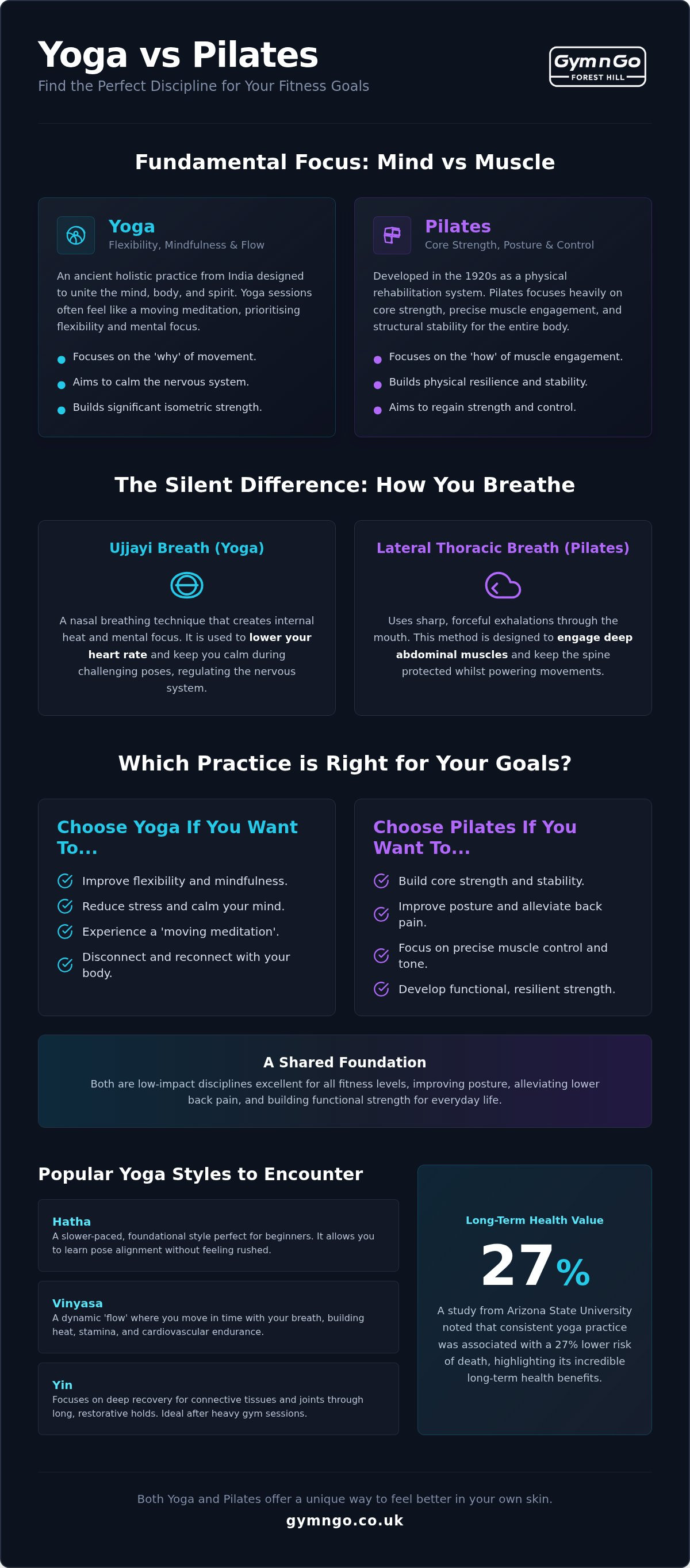
Choosing between these two popular practices doesn't have to be a headache. Both are low-impact, bodyweight-focused disciplines that genuinely improve your daily quality of life. Whilst they share some DNA, they offer very different experiences for your body and mind. In 2026, fitness has moved toward functional longevity, and both sessions have evolved to meet these modern standards. Yoga typically prioritises flexibility and mindfulness, whilst Pilates focuses heavily on core strength and structural stability.
When considering yoga vs pilates, it's helpful to look at what your body needs right now. If you feel tight and scattered after a long week, yoga might be the answer. If you feel weak in your posture or have nagging back pain from desk work, Pilates could be your best friend. Both are incredible for building functional strength that carries over into your daily life in Forest Hill. Whether you're lifting groceries or running for the train, the body awareness you gain is invaluable.
The Core Philosophy: Mind vs Muscle
Yoga is a holistic practice with roots in ancient India. It was originally designed to unite the mind, body, and spirit through movement and stillness. This creates a session that often feels like a moving meditation. In contrast, Wikipedia's explanation of Pilates notes it began as a physical rehabilitation system. Joseph Pilates developed the method in the 1920s to help people regain their strength and control. These different origins dictate the feel of a modern class. You'll find yoga leans into the 'why' of the movement, whilst Pilates focuses on the 'how' of the muscle engagement.
Breathwork: The Silent Difference
The way you breathe changes everything about your workout. In a yoga class, you'll likely use Ujjayi breath, which is a specific nasal breathing technique used as a tool for creating internal heat and mental focus. This helps lower your heart rate and keeps you calm during challenging poses. Pilates takes a different approach by using lateral thoracic breathing. You'll use sharp, forceful exhalations through the mouth to engage the deep abdominals and keep your spine protected. Your breathing style determines your heart rate and stress response during the session. One calms the nervous system, while the other powers the muscles.
By 2026, we've seen a massive shift towards nervous system regulation in the fitness industry. Yoga helps you switch off after a high-pressure day, whilst Pilates gives you the physical resilience to handle one. They are two sides of the same coin, each offering a unique way to feel better in your own skin. Everyone is welcome to try both and see which rhythm suits their lifestyle best.
The Ancient Art of Yoga: Flexibility, Mindfulness, and Flow
Yoga is far more than a sequence of gentle stretches. It’s a complete physical system that builds significant isometric strength. When you hold a pose like "Warrior II" or "Plank," you're engaging multiple muscle groups simultaneously to maintain stability. Many people avoid the mat because they think they aren't flexible enough. In reality, flexibility is the result of a consistent practice, not a prerequisite. If you can breathe, you can do yoga. It’s about meeting your body where it is today and seeing where it can go.
When weighing up yoga vs pilates, many Londoners find the meditative aspect of yoga particularly helpful for managing high-pressure careers. A 2026 study from Arizona State University noted that yoga was associated with a 27% lower risk of death, highlighting its incredible long-term health value. According to the Cleveland Clinic on the origins of yoga and pilates, yoga’s spiritual roots provide a unique mental escape that differs from the rehabilitative focus of other methods. It offers a space to disconnect from the digital world and reconnect with your physical self.
Popular Styles You Might Encounter
Choosing a style depends on your energy levels and fitness goals. Hatha is a slower-paced, foundational style that is perfect for beginners in SE23. It allows you to learn the alignment of each pose without feeling rushed, whilst building a solid foundation for your practice. If you want to build heat and stamina, Vinyasa is a dynamic flow where you move in time with your breath. This "flow" builds genuine cardiovascular endurance and keeps your mind focused on the present moment. For those needing deep recovery after a heavy gym session, Yin focuses on connective tissues and joint health through long, restorative holds that target the fascia.
Mental Wellbeing and Stress Reduction
A busy day in the City often leaves your cortisol levels spiked and your mind racing. Yoga helps lower these stress hormones through intentional movement and controlled breathing. The most important part of any session is "Savasana," or final relaxation. This final five minutes of stillness allows your nervous system to reset and provides much-needed mental clarity before you head back home. For a deeper look at local options, check out our Yoga Forest Hill London guide to finding balance in your neighbourhood. It’s a great resource for anyone looking to start their wellness journey in SE23.
Everyone is welcome to join our community and explore these benefits firsthand. If you're ready to start your journey, you can book a class at our Forest Hill centre today and see how a regular practice can transform your outlook.
The Science of Pilates: Core Strength, Posture, and Control
While yoga focuses on flow and flexibility, Pilates is a masterclass in structural engineering for the human body. The entire practice revolves around the "Powerhouse." This is the area between your ribs and hips, serving as the central engine room for every movement. Unlike traditional gym exercises that often rely on momentum, Pilates uses small, controlled movements to target deep stabilising muscles. This approach is why it's so effective for spinal health. If you spend your day hunched over a laptop in Forest Hill, these sessions help correct "office posture" by lengthening the spine and strengthening the back muscles that support it.
Athletes and weightlifters often add Pilates to their routine as a tool for injury prevention. It builds the internal support system needed for heavier lifts and more intense sports. Data from 2026 shows that Pilates participation has grown alongside a 30% increase in younger adults seeking functional fitness. When comparing yoga vs pilates for physical resilience, Pilates often wins for those needing targeted rehabilitation. It teaches you how to move with intention rather than just effort.
Mat Pilates vs Reformer Pilates
Mat Pilates is the essential foundation of the method. It uses your own bodyweight and gravity to provide resistance, which is why it's so effective for building functional strength. You might also encounter Reformer machines that use a system of springs and pulleys to add resistance. However, starting with mat-based sessions is often the best way to master the basics. It forces you to control your own body without the assistance of a machine, ensuring you've actually switched on the right muscles before adding complexity.
The Six Principles of Pilates
The practice is built on six core principles: Centring, Concentration, Control, Precision, Breath, and Flow. These aren't just abstract ideas. They translate directly to better movement in your everyday life. Precision is particularly vital in this discipline. It prevents the common "cheating" often seen in standard gym exercises where larger muscles take over to finish a rep. By focusing on exact alignment, you ensure that every movement serves a purpose. This level of focus is what creates the long, lean muscle tone associated with the practice. Everyone can benefit from this mindful approach to strength, regardless of their starting point.
Building a stronger core is the best gift you can give your future self. If you're ready to improve your posture, our team is here to help you get started. You can grab a free 1-day guest pass and try a session at our Sunderland Road centre to feel the difference for yourself.
Side-by-Side Comparison: Choosing the Right Path for Your Goals
Deciding between yoga vs pilates often comes down to your primary motivation. People frequently ask which one is harder, but the truth is that both offer infinite progression. A basic yoga pose can become a complex arm balance. A simple Pilates leg circle can evolve into a gruelling core sequence. You'll never "finish" either practice. Your equipment needs are also quite similar. Yoga requires little more than a mat and perhaps a couple of foam blocks for support. Pilates is equally accessible on a mat, though you might eventually use small props like resistance bands or weighted balls to increase the challenge. Both are designed to fit into your life without requiring a van-load of gear.
Best for Back Pain and Posture
If your main goal is injury rehabilitation, particularly for lower back issues, Pilates is often the superior choice. It focuses on deep abdominal engagement and structural support. This helps take the pressure off your spine and teaches you how to sit and stand correctly. Yoga is also a powerful tool for recovery, but it works differently. It helps alleviate tension-based pain through mindful stretching and opening up tight areas like the hips and chest. This is especially helpful if your pain comes from stress or long hours at a desk. If you're managing a specific injury, we recommend speaking with a personal trainer Forest Hill London to see which practice fits your recovery path best.
Best for Weight Loss and Toning
When comparing yoga vs pilates for body composition, both practices play different roles. Dynamic styles of yoga, like Vinyasa flow, have a higher calorie-burning potential because they keep your heart rate elevated through constant movement. Pilates is renowned for its muscle-sculpting focus. It creates a toned look by targeting smaller, stabilising muscles that traditional gym machines often miss. Neither should be your only tool for weight loss. They work best as supporting pillars alongside a balanced routine. In 2026, we see more people integrating these classes into a flexible gym membership Forest Hill plan to get the best of both worlds. This approach builds a body that is both strong and mobile.
Everyone is welcome to try a session and see which one feels right for their body. If you're ready to start, claim your free 1-day guest pass and join us at our Forest Hill centre this week.
Beyond the Choice: Integrating Yoga and Pilates at Gym n Go Forest Hill
Gym n Go Forest Hill is more than just a gym. It's a space where you don't have to choose sides in the yoga vs pilates debate. Many of our members find that a hybrid approach works best for their busy SE23 lifestyle. You might join a yoga session on a Tuesday to decompress after a long day, then hit a Pilates class on Thursday to build the structural strength needed for your weekend runs. Our centre at 1-9 Sunderland Road is designed to be a local hub where fitness fits naturally into your routine.
We pride ourselves on being an inclusive environment. There is no boutique studio intimidation here. You won't find high-pressure sales or a "members only" clique. Instead, you'll find a friendly, professional team and state-of-the-art equipment. Everyone is welcome, regardless of their starting point or previous experience. We believe that fitness should be accessible and encouraging for all. It's about feeling comfortable while you work towards your personal goals.
The Forest Hill Community Environment
A local fitness centre provides a grounded, results-driven atmosphere that you won't find in a faceless chain. It's about belonging to a space where the staff know your name and your goals. You'll meet like-minded SE23 residents in our group fitness classes Forest Hill, creating a sense of community that keeps you motivated. We understand the demands of the London commute. Our extended opening hours ensure you can fit a session in before or after your trip to London Bridge without feeling rushed.
How to Get Started Today
Starting your journey is simple and stress-free. You can book your first session directly through the Gym n Go Forest Hill website in just a few clicks. There’s no need for fancy designer gear or expensive equipment. Just wear comfortable clothes that allow you to move freely and bring a water bottle to stay hydrated. We provide a welcoming space where you can focus entirely on your progress.
If you’re still unsure about which style to try first, come in and speak with our friendly staff. We love giving personal recommendations based on your specific needs. You can even use a free 1-day guest pass to trial both styles and see which one resonates with you. We’re here to support you every step of the way, ensuring your fitness journey is as rewarding as it is effective. Your path to a stronger, more flexible you starts right here in the heart of Forest Hill.
Find Your Perfect Balance in SE23
Choosing between yoga vs pilates isn't about finding a "winner," but about discovering what supports your body today. We have explored how one builds structural resilience whilst the other fosters a calm, focused mind. By integrating these practices, you create a well-rounded fitness foundation that keeps you moving well for years to come. It’s about finding a rhythm that fits your lifestyle and helps you feel more energised in your daily life.
At Gym n Go Forest Hill, we have cultivated a welcoming SE23 community where everyone feels at home. Our expert instructors are dedicated to supporting all fitness levels, ensuring you feel confident from your very first session. With our no-contract, flexible membership plans, you have the freedom to explore both disciplines without being tied down by long-term commitments. We take pride in providing a professional yet approachable space for our neighbours to thrive.
Ready to start your journey? Claim your Free 1-Day Guest Pass at Gym n Go Forest Hill today and experience our friendly centre for yourself. We look forward to seeing you on the mat soon and helping you achieve your personal best.
Frequently Asked Questions
Is yoga or Pilates better for losing belly fat?
Neither practice is a magic solution for fat loss, but both are excellent for improving body composition. Yoga often burns more calories during dynamic flow sessions, while Pilates focuses on building the lean muscle that keeps your metabolism active. For the best results in SE23, we suggest using these classes to support a balanced routine of movement and healthy habits.
Can I do both yoga and Pilates in the same week?
Yes, combining these disciplines is a brilliant way to build a well-rounded fitness foundation. By alternating between yoga vs pilates, you can work on structural core strength one day and deep, mindful flexibility the next. This variety helps prevent overtraining and keeps your routine interesting. Many of our members find that this balanced approach leads to better long-term results.
Do I need to be flexible to start yoga classes in Forest Hill?
You don't need to be flexible at all to start your first class. Flexibility is a result of the practice, not something you need to have before you begin. Our instructors are trained to offer modifications for every body type and ability level. We welcome everyone in our local community to come as they are and progress at their own pace.
Which is better for chronic lower back pain?
Both can help, but they approach pain relief from different angles. Pilates is often the preferred choice for structural support because it strengthens the deep abdominal muscles that protect the spine. Yoga is excellent for releasing the tight hips and hamstrings that often cause back discomfort. If you are managing a specific condition, our team can help you choose the right starting point.
What should I wear to my first Pilates class at Gym n Go Forest Hill?
We recommend wearing comfortable, breathable exercise clothes that allow you to move freely. Form-fitting gear like leggings or joggers is often helpful so your instructor can check your alignment, but anything you feel confident in is fine. At Gym n Go Forest Hill, we want you to feel relaxed and ready to move. Just avoid clothing with bulky zips or buttons that might be uncomfortable on the mat.
Is yoga or Pilates harder for a complete beginner?
Neither is inherently "harder," but they do challenge you in different ways. Pilates requires a high level of concentration on specific, controlled muscle movements from the start. Yoga involves learning new poses and breathing techniques that might feel unfamiliar at first. Both practices are designed to meet you at your current level, so you will never feel like you've been thrown into the deep end.
How many times a week should I practice to see results?
Most people start to see and feel significant changes by attending two to three sessions per week. Consistency is the most important factor when you are building a new habit. You will likely notice better posture and increased energy after just a few weeks of regular attendance. It is all about finding a frequency that fits sustainably into your existing weekly schedule.
Are these classes included in the standard Gym n Go Forest Hill membership?
We offer several different membership tiers at Gym n Go Forest Hill to ensure there is an option for everyone. Some of our flexible plans include all group sessions as standard, while others may operate on a pay-as-you-go basis for specialist classes. You can easily check your current plan on our website or speak with our friendly team at the Sunderland Road centre for a full breakdown of your options.


Comments