
Pilates for Beginners: Complete UK Starter Guide for 2026

Updated: Oct 1
You don't need to be flexible, graceful, or already in peak shape to step onto a Pilates mat. If you've spent months looking at studio videos filled with intricate reformer beds, it's completely natural to worry about feeling clumsy or out of place. Nagging lower back stiffness from long desk hours can make starting a new routine feel daunting, whilst mixed messages about breathing patterns and core alignment only add to the confusion. That is why pilates for beginners is built around steady, supportive movement that meets your body exactly where it is today.
You'll discover how to develop foundational strength safely, master key alignment principles, and walk into your first session with quiet confidence. We will demystify the difference between matwork and reformer classes, outline essential starter exercises you can try at home, and show you exactly what to wear, bring, and expect on day one.
Table of Contents
What Is Pilates? Core Principles Explained for Beginners
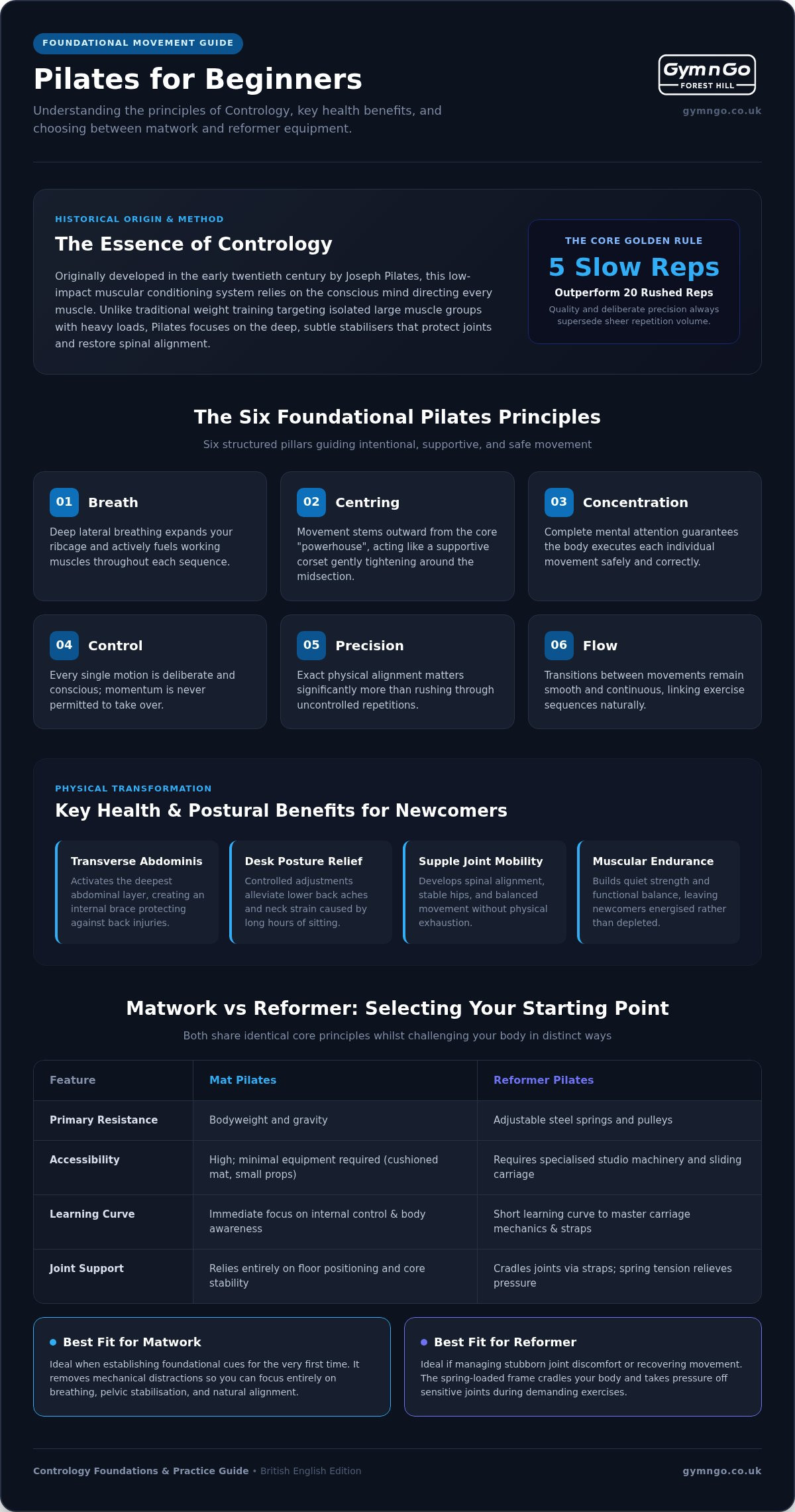
Pilates is a form of low-impact muscular conditioning designed to build core stability, refine posture, and restore balanced movement across your entire body. Originally developed in the early twentieth century by Joseph Pilates, he named his system "Contrology" because it relies on the conscious mind directing every physical muscle. If you want a deeper look into the history and evolution of this discipline, exploring What is Pilates provides helpful context on its journey from physical rehabilitation to modern studios.
Unlike traditional gym lifting, you won't find rapid repetitions or heavy dumbbells here. Conventional weight training focuses on isolating large muscle groups under heavy loads. Pilates does the opposite. It targets the deep, subtle stabilisers that protect your joints and align your spine. These controlled adjustments actively relieve the postural strain and lower back aches that come with sitting at an office desk all day.
The Six Foundational Pilates Principles
Every exercise relies on six core principles that guide how you move:
Breath: Deep lateral breathing expands your ribcage and fuels active muscles.
Centring: Movement stems outward from your core centre, often called the "powerhouse". Visualise a supportive corset gently tightening around your midsection.
Concentration: Complete mental attention guarantees your body executes each movement correctly.
Control: Every motion is deliberate; momentum never takes over.
Precision: Exact alignment matters far more than rushing through messy repetitions.
Flow: Transitions remain smooth and continuous, linking each sequence naturally.
In pilates for beginners, quality always supersedes quantity. Five slow, well-aligned repetitions will strengthen your body far more effectively than twenty rushed attempts.
Key Health and Postural Benefits for Newcomers
Starting out brings immediate, noticeable improvements to daily life. You'll develop better spinal alignment, stable hips, and supple joint mobility without feeling exhausted. By engaging your transverse abdominis, the deepest layer of abdominal muscle, you create a natural internal brace that guards your lower back against everyday injuries. Over time, this quiet muscular endurance builds better balance and leaves you feeling energised after every session.
Mat vs Reformer: Choosing Your Beginner Starting Point
Stepping into your first session usually starts with a choice between two formats: matwork or the reformer. Both share identical principles, but they challenge your body in completely different ways. Many newcomers assume reformers are reserved strictly for seasoned athletes, yet the spring-loaded frame was actually invented to support bodies through rehabilitation. Understanding how each approach works helps you choose the right path for your starting point.
Mat Pilates: Mastering Bodyweight and Gravity
Reformer Pilates: Spring Resistance and Structural Support
A reformer consists of a sliding carriage set inside an elevated frame, rigged with varying spring tensions, shoulder rests, and looped ropes. While the machine looks complex at first glance, the springs can actually assist you by taking pressure off sensitive joints during demanding movements. Because setting spring tensions requires personalised guidance, reformer sessions typically run in smaller groups with hands-on coaching to guarantee safe positioning. Behind the scenes, instructors often rely on dedicated class-planning resources like reformerflow.app to sequence smooth, balanced workouts tailored to different skill levels.
How to Decide Which Style Suits You Best
If you're establishing foundational cues for the very first time, matwork is often the most straightforward place to begin. It removes mechanical distractions so you can focus entirely on breathing and alignment. That said, if you manage stubborn joint discomfort, reformer springs offer targeted support that makes certain ranges of motion easier to access. Why not try both formats to discover what feels most rewarding? If you want to explore supportive group sessions in a friendly community space, you can visit Gym n Go to book a class or browse the official NHS guide to Pilates for additional movement tips.
Essential Beginner Exercises to Practise with Confidence
Precise alignment always takes priority over speed. Before attempting any movement, you need to understand how your back rests against the mat. Lie on your back with knees bent and feet flat on the floor. In a neutral spine, your natural lower-back curve leaves a tiny space, just enough for a grape to rest under your waistband without being crushed. An imprinted spine occurs when you gently tilt your pelvis to press that curve flat against the mat. Practise this subtle rock back and forth. You'll quickly feel the difference.
Pair this setup with lateral ribcage breathing. Place your hands flat against the sides of your ribcage. Inhale deeply through your nose, expanding your ribs sideways into your palms like an accordion, without letting your chest or shoulders creep up towards your ears. As you exhale through pursed lips, draw your navel gently inwards and upwards. Mastering this breathing rhythm is essential in pilates for beginners, as recommended in the clinical guidance within the NHS guide to Pilates.
Step-by-Step Starter Movements
Start with these four core movements to build stability safely:
The Modified Hundred: Lie on your back with knees raised to tabletop at ninety degrees. Lift your head and shoulders slightly, reaching arms long by your sides. Pump your arms gently up and down, inhaling for five counts and exhaling for five counts.
Pelvic Curl: Keep feet hip-width apart on the floor. Exhale as you tuck your pelvis and peel your spine off the mat bone by bone, pausing at the top before rolling down slowly.
Bird-Dog: Start on hands and knees with a flat back. Reach your right arm forward and left leg back simultaneously, keeping your hips square before returning to the floor.
Spine Stretch Forward: Sit tall with legs outstretched in front of you. Inhale to lengthen your spine, then exhale as you round forward from your upper back, stretching hamstrings gently.
Modifications for Stiff or Sensitive Bodies
Never force a position that causes sharp pain. Place a folded hand towel beneath your head if your neck feels strained during curl-ups. If holding both legs in tabletop pinches your hip flexors, keep one foot planted firmly on the mat while the other works. You can also rest on your forearms during all-fours exercises if tender wrists bother you.
Classic Beginner Errors to Watch For
Watch out for three common mistakes on your mat:
Holding your breath: Beginners often freeze during challenging sequences. Exhale audibly through your mouth whenever you execute the working phase of a movement.
Abdominal doming: Pushing your tummy outward creates strain. Always focus on pulling your waistband inwards towards your spine.
Arching the lower back: When extending a leg, stop before your lower spine lifts off the mat. Keeping your pelvis steady matters far more than reaching far.
Preparing for Your First Studio Class: What to Expect
Most studio sessions run between 45 and 60 minutes. The coach begins with gentle breathing and mobility warm-ups to wake up your spine. Next comes a progressive main block targeting core, back, and hip strength. The class finishes with relaxing full-body stretches to release muscular tension. You'll leave feeling grounded, tall, and refreshed.
What to Wear and Pack in Your Gym Bag
Choose comfortable, form-fitting sportswear such as high-waisted leggings or tapered joggers paired with a breathable t-shirt. Avoid loose clothing with metal toggles or rear zips that dig into your back while lying down. Form-fitting kit also allows your coach to spot your pelvic alignment quickly and offer helpful cues.
Packing your bag takes only a minute:
Grip socks: Specialised socks with rubberised soles offer vital traction on wooden floors and keep shared mats hygienic.
Water bottle: Bring a refillable bottle to stay hydrated through active breathing sets.
Small hand towel: Useful for dabbing sweat or folding beneath your forehead during prone exercises.
Tie longer hair back securely and leave dangling jewellery at home so nothing catches on mats or equipment.
First-Day Studio Etiquette and Coach Communication
Arrive ten minutes early so you can settle in without rushing. Introduce yourself to the coach at the front desk and mention that it's your first time. Let them know about any existing injuries, lower back sensitivity, or if you might be pregnant. Sharing this allows them to suggest seamless modifications throughout the routine.
Remember that pausing to rest is completely normal. In pilates for beginners, listening to your body shows genuine control. If your neck feels tired or an abdominal burn gets too intense, simply lower your head to the mat, take two deep breaths, and rejoin when ready. If you want to experience this supportive environment firsthand, claim a free 1-day guest pass at Gym n Go and discover how welcoming a local studio session can be.
Starting Your Pilates Journey at Gym n Go Forest Hill
Fitness feels far easier when you practise in a space where you genuinely belong. Based at 1-9 Sunderland Road, Gym n Go Forest Hill operates as an encouraging neighbourhood fitness centre for South East London. Rather than navigating crowded corporate facilities or staring at generic mobile workout apps, you get personalised attention from coaches who care about your form. Our welcoming group classes remove the performance pressure, creating a calm environment where beginners can learn at their own pace.
Building a sustainable routine means having options that adapt to your lifestyle. By combining mindful core work with our wider gym facilities and group fitness timetable, you can build balanced, functional strength that carries over into everyday life.
Welcoming Classes in the Heart of SE23
Our dedicated Yoga and Pilates class timetable balances restorative matwork with clear, encouraging coaching. Instructors lead each sequence with gentle cues, making sure every participant feels included regardless of age or fitness background. Located just moments from Forest Hill station, the club makes it simple to fit a restorative movement session into your morning commute or evening unwind.
Complementing Your Routine with Balanced Training
Pilates forms an exceptional foundation, but pairing it with diverse training accelerates your results. Here is how our community members make the most of their time:
Targeted Core Strength: Match low-impact matwork with personal training sessions to tailor your posture and mobility goals.
Total-Body Conditioning: Combine weekly classes with group fitness sessions to enhance cardiovascular stamina and overall energy.
Flexible Habit Building: Choose flexible membership options that work around your personal schedule without locking you into rigid routines.
Surrounding yourself with supportive local members keeps consistency high and turns exercise into something you look forward to each week.
Take Your First Step with a Free Guest Pass
Stepping into a new club should feel completely stress-free. Come visit our Sunderland Road centre, view our studios, and meet our friendly instructors before deciding what suits you best. Our front desk team is always available to chat about the timetable and point you towards the best slots for pilates for beginners. Claim your free 1-day guest pass today to experience our warm community atmosphere firsthand.
Step onto the Mat and Build Lasting Core Strength
Starting something new always feels like a leap, but building genuine strength doesn't require prior flexibility or complicated athletic background. By focusing on breath control, finding your neutral spine, and mastering fundamental movements, you give your body the exact support it needs to sit taller and move without stiffness. Whether you choose bodyweight floorwork or spring-assisted equipment, pilates for beginners offers a sustainable path towards balanced wellbeing.
You don't have to navigate that journey on your own or rely on guesswork from online videos. Located at 1-9 Sunderland Road, Gym n Go Forest Hill provides a friendly, welcoming neighbourhood centre where supportive instructors guide newcomers through every movement safely. With flexible membership tiers and zero high-pressure sales tactics, establishing a healthy weekly habit fits easily into everyday life. When you're ready to experience a supportive local class, claim your free 1-day guest pass at Gym n Go and take your first confident step today.
Frequently Asked Questions
Is Pilates suitable for complete beginners who are not flexible?
Yes, Pilates is entirely suitable for beginners with limited flexibility. You do not need to touch your toes or twist into complex shapes to participate. Movements are intentionally low impact and easily adapted with bent knees, cushions, or reduced ranges of motion. The primary goal is teaching you to stabilise your core and align your spine comfortably, allowing flexibility to develop naturally over time.
How often should a beginner do Pilates each week to see results?
Attending two to three sessions per week delivers noticeable improvements in posture and strength. Consistency matters far more than intensity. Even a single focused session paired with a few short home movement drills will help your muscles remember proper alignment cues. At Gym n Go in Forest Hill, our timetable makes it simple to space out classes evenly across your working week.
Can Pilates help relieve lower back pain and poor desk posture?
Pilates directly targets the postural fatigue and nagging aches caused by prolonged desk sitting. By strengthening deep stabilising muscles, particularly the transverse abdominis, it creates a protective internal corset around your spine. Controlled segmental movements also mobilise stiff thoracic joints and open tight hip flexors, taking repetitive pressure off your lumbar vertebrae so you sit taller with less daily discomfort.
What is the main difference between yoga and Pilates classes?
The main difference lies in the core mechanism and focus of movement. Yoga focuses on holding static postures, expanding flexibility, and connecting breath with mindfulness. Pilates concentrates on dynamic core conditioning, spinal articulation, and joint control. While both disciplines share matwork foundations, pilates for beginners prioritises building functional pelvic stability and deep muscular control rather than spiritual or flow-based poses.
What should I wear to my very first beginner Pilates session?
Wear breathable, fitted sportswear such as high-waisted leggings, close-fitting shorts, and a comfortable t-shirt. Avoid loose clothing with metal buttons or back zips that dig into your spine when lying down. Form-fitting kit helps coaches assess your alignment quickly. Bring a pair of grip socks to maintain secure footing on the studio floor, along with a refillable water bottle.
Will Pilates help me lose weight or build muscle tone?
Pilates builds lean, defined muscular endurance rather than bulky mass. It tones your midsection, glutes, and upper back through continuous low-impact tension. While it burns moderate calories, combining weekly studio sessions with cardiovascular group fitness classes or personal training at our Forest Hill gym SE23 creates the most balanced approach for shedding body fat and boosting overall metabolism.
What happens if I cannot keep up during a group Pilates class?
You can pause and rest whenever you need without feeling awkward or judged. Group classes are deliberately collaborative, not competitive. Supportive studio instructors expect people to take breathers, reset their posture, or choose simpler movement variations. In pilates for beginners, recognising when your muscles need a brief pause demonstrates great body awareness and prevents poor form.


Comments