
What Does a Personal Trainer Do? One-to-One Coaching Guide

What if one-to-one training is less about being pushed to your limit and more about finding a plan that works for you? If the question “what does a personal trainer do” is on your mind, you may be looking for guidance without knowing what to expect, or wondering what you’ll be asked to do between sessions.
It’s reasonable to want coaching that feels supportive, not intimidating. A personal trainer can help turn a broad goal into manageable steps, guide you through exercises and adjust the approach to suit your needs and feedback. Progress is a shared process: your trainer brings structure and exercise knowledge, while you bring your goals, preferences and honest thoughts about what feels manageable.
This guide explains what a trainer’s role can involve, how a typical one-to-one session might work and what you can do between sessions. You’ll also learn how to talk about your goals and concerns, so you can decide whether personal training suits you right now. At Gym n Go Forest Hill, one-to-one coaching takes place in a welcoming local gym environment.
Table of Contents
What does a personal trainer do, and what is their role?
A personal trainer provides tailored exercise guidance and coaching. Their role is to help you work towards an agreed fitness goal with a plan shaped around your experience, preferences and practical needs. If you’ve wondered what does a personal trainer do beyond leading a workout, the answer includes planning, demonstrating, observing and adapting. The focus of your sessions is agreed between you and your trainer.
Personal training is a shared process. Your trainer brings exercise knowledge and guidance; you bring your aims, effort and feedback. Say if an exercise feels uncomfortable, a movement is unclear or your circumstances change. That information helps your trainer decide whether to explain, adjust or revisit an exercise, rather than assuming the plan works without your input. For a general overview of the role of a personal trainer, you can also read about how personal training combines exercise instruction and support.
What are a personal trainer’s main responsibilities?
A trainer can help turn a broad intention, such as becoming stronger, into a clear focus for your sessions. That might mean practising a particular movement or building familiarity with a set of exercises. Goals should reflect what matters to you and suit your starting point, rather than being imposed as a one-size-fits-all target.
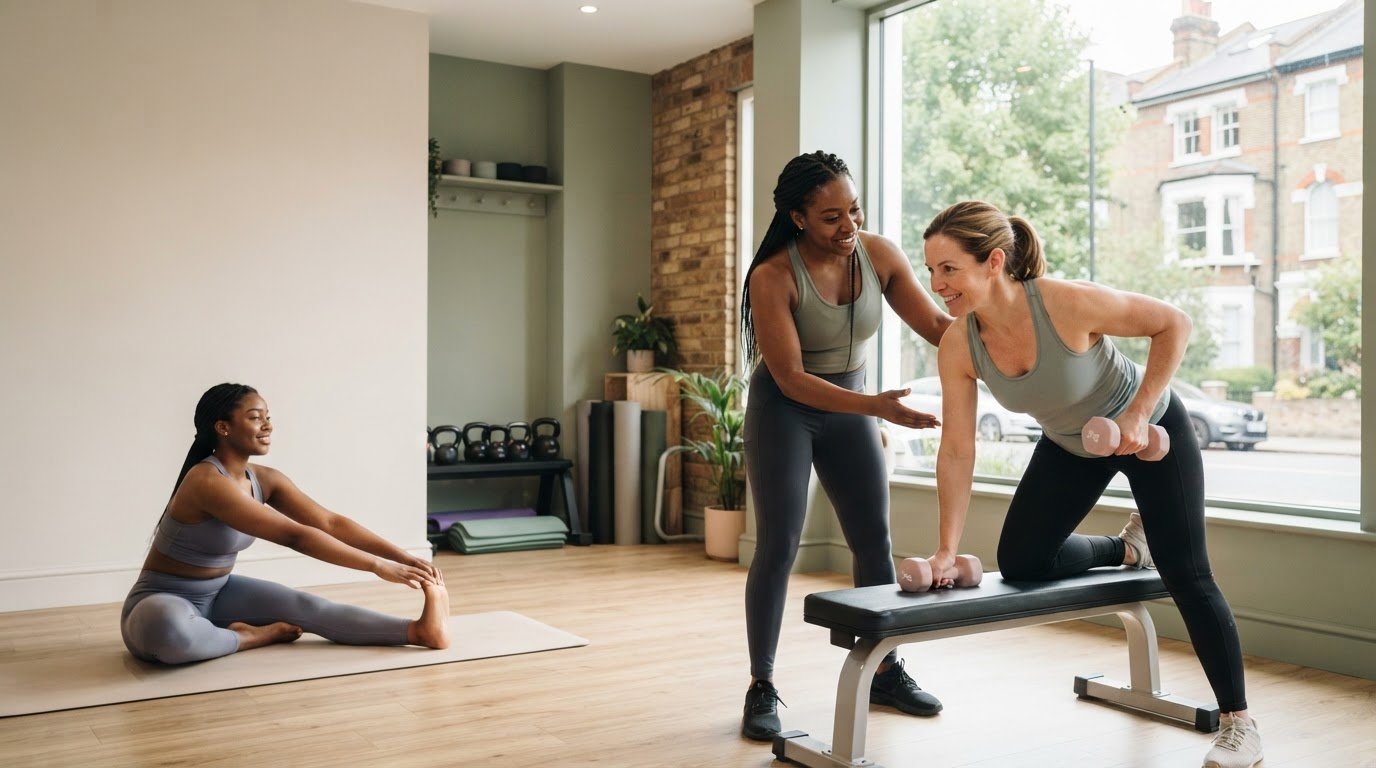
Your trainer selects exercises that fit the agreed focus, demonstrates how to do them and watches as you practise. Their guidance might include a reminder about your position, the pace of a movement or how to make an exercise simpler or more challenging. The aim is to give you useful information you can act on, not to overwhelm you with instructions.
Good coaching also involves listening. If you’re unsure why an exercise is included, ask. Understanding its purpose can help you feel more confident and engaged in the session.
What does a personal trainer not do?
Personal training is more than counting repetitions or choosing weights for you. Those details may be part of a session, but coaching also means paying attention to how you move, explaining exercises and responding to your feedback. You’re not expected to follow instructions silently or have everything figured out before you begin.
A trainer can support your efforts, but can’t promise a particular change in your appearance, strength or fitness. Progress depends on your individual circumstances and participation, so treat goals as a direction for your work, not a guaranteed result.
Exercise coaching isn’t medical care. A personal trainer doesn’t diagnose or treat health conditions, and you shouldn’t rely on them for medical advice. If you have a health concern, injury or symptoms that affect exercise, speak with an appropriate healthcare professional. Nor should you assume that personal training includes nutrition advice. Keep the focus on the exercise support you’ve agreed with your trainer, and share relevant concerns so that the coaching can be approached with care.
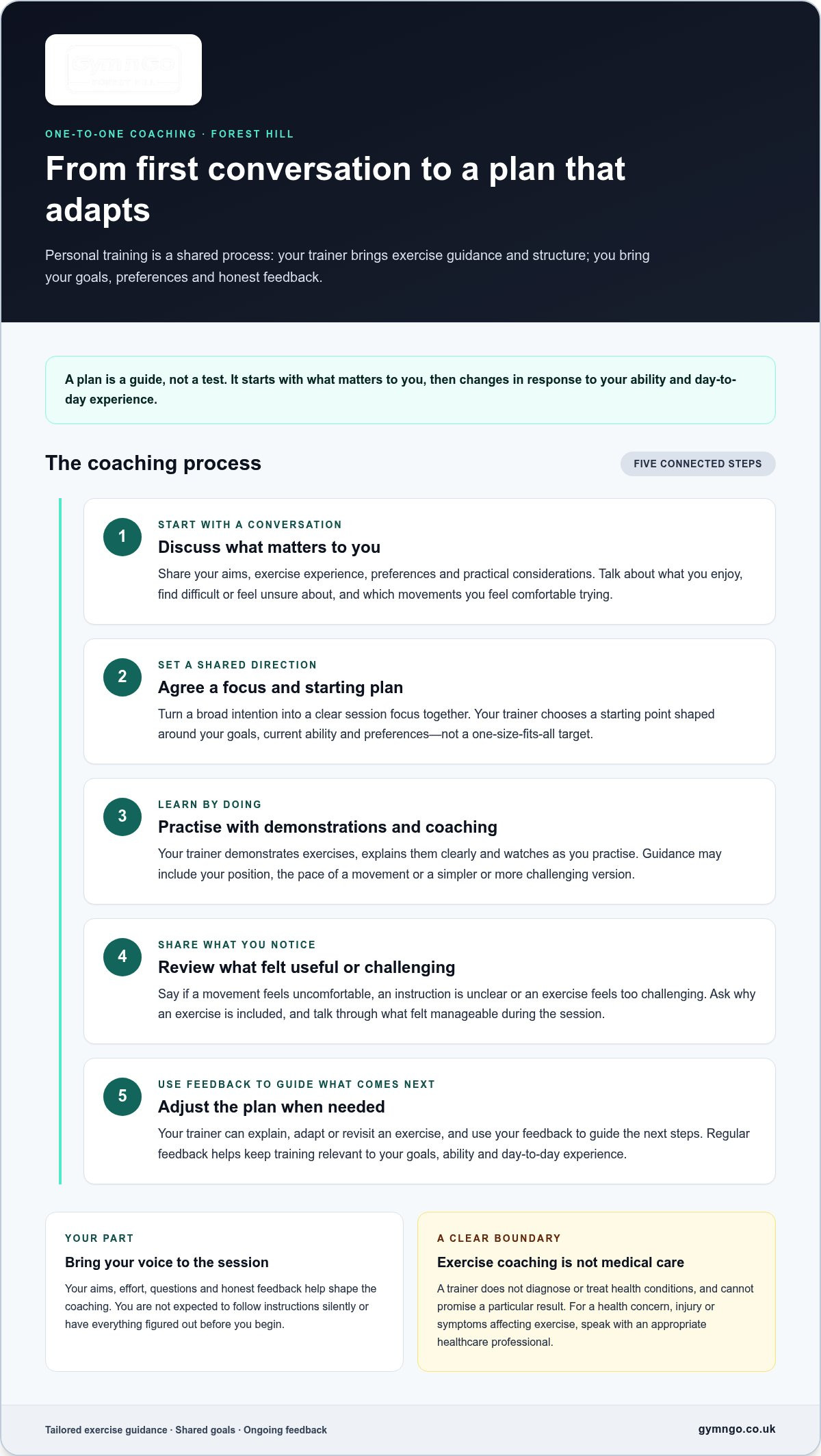
How does personal training work from the first conversation onwards?
Personal training usually follows a flexible sequence: talk about what you want to work on, agree a plan, practise the exercises, review how it’s going and adjust where needed. The opening conversation helps your trainer understand your experience, preferences and practical constraints, such as which movements you feel comfortable trying and what you’d like to prioritise.
You don’t need a polished fitness plan before you begin. Be open about what you enjoy, what you find difficult and what you hope to achieve. Your trainer can use that information to choose a starting point, then adapt the exercise choices and level of challenge to your current ability. The plan is a guide, not a test you have to pass.
Discuss: Share your aims, experience, preferences and relevant practical considerations.
Agree: Choose a session focus and a suitable starting plan together.
Practise: Work through exercises with demonstrations and coaching.
Review: Talk about what felt manageable, useful or challenging.
Adjust: Use that feedback to guide the next steps.
Regular feedback helps keep your training plan relevant to your goals, ability and day-to-day experience.
What happens before a personal training session?
Before exercise begins, agree what to focus on and tell your trainer how you’re feeling. Your previous experience and current aims help shape the session, while your preferences can guide which exercises you practise. Raise anything that’s on your mind at the start. Perhaps you’re unsure about a movement, would rather build confidence with the basics or want to talk through how an exercise feels. Sharing this early gives you and your trainer a chance to approach the session thoughtfully.
How does a trainer guide and review a workout?
Your trainer can demonstrate an exercise, explain what to do in clear language and offer feedback as you practise. Ask questions or say if an instruction doesn’t make sense. That exchange helps you understand the movement rather than simply copying it.
If an exercise feels too challenging or unsuitable, tell your trainer. They can consider a different option or adjust the level of difficulty to better match your current ability. Reviewing a goal is also a chance to discuss what you’ve practised and what you’d like to work on next. It isn’t a promise that you’ll reach a particular result by a set date.
If you’d like to talk through your aims in a welcoming one-to-one setting, arrange a free personal training consultation with Gym n Go in Forest Hill. Use the conversation to share what you want from coaching and what would help you feel comfortable getting started.
Do personal trainers push you too hard, or are they only for beginners?
Personal training shouldn’t be about intimidation or making every workout as tough as possible. Good coaching responds to the person in front of the trainer, including their experience, goals and comfort. Ask for a manageable pace and clear options, then share how an exercise feels as you go.
Personal training isn’t only for beginners, either. If you’re new to the gym, individual guidance can help you learn movements and feel more at ease. If you already train regularly, you might want help practising a particular skill, adding structure or working towards a different goal. Asking what does a personal trainer do is really asking what kind of support would make your own exercise more purposeful.
Is personal training suitable if you are new to the gym?
Yes. You don’t need to know your way around gym equipment or arrive with the right exercise vocabulary. A trainer can demonstrate movements, explain them in plain English and give you time to practise. Tell them what feels unfamiliar, whether that’s using a piece of equipment, following instructions or simply getting started. Your questions help them pitch their guidance at a level that feels clear and comfortable.
Will a personal trainer make every workout intense?
No. A session can include an appropriate challenge without pushing you beyond what feels manageable. A trainer might adjust an exercise, change its pace or offer a simpler option if you’re finding it too difficult. Equally, if something feels comfortable and you want to progress, discuss whether a more challenging variation makes sense. Useful coaching is responsive, not a test of how much discomfort you can tolerate.
Be direct about what you’re experiencing. You might say, “Could you show me a gentler option?” or “Can we slow that down?” If an exercise causes pain or you feel unwell, stop and explain what’s happening. Clear feedback gives your trainer information to respond to; staying quiet can make it harder for them to understand what you need.
Personal training can provide structure and guidance, but it can’t create consistency or guarantee results for you. Your participation matters, and the plan needs to fit your circumstances if you’re going to keep engaging with it. You can decide what a useful session looks like together. It might be learning a movement, building confidence with equipment or completing a workout at a steady pace. A session doesn’t have to leave you exhausted to feel worthwhile.
Whether you’re taking your first steps or refining an established routine, you’re allowed to set boundaries and ask questions. Coaching works best as a conversation, with room to explain what you want to achieve and what feels right for you.
How can you get more from personal training sessions?
A little preparation can help make one-to-one coaching more focused. You don’t need to arrive with all the answers. Think about what you’d like to work towards and what information could help your trainer shape the sessions around you. Knowing what does a personal trainer do is useful, but sharing what you need from the experience makes the guidance more personal.
Use this simple checklist before you begin:
Choose a goal: Pick an action or skill you want to work on, such as learning a movement or building a regular exercise routine.
Share your experience: Explain what exercise you’ve tried, what you enjoy and what feels unfamiliar.
Raise concerns: Mention preferences, confidence, time constraints or anything that could affect how you take part.
Speak up during sessions: Tell your trainer what feels clear, difficult or comfortable as you practise.
Useful goals focus on things you can take part in and practise. For example, you might aim to learn how to use a piece of equipment or become more confident with a particular exercise. These give you something practical to discuss and review. Avoid treating a change in appearance or performance as a guaranteed outcome. Your trainer can guide the exercise process, but results can’t be promised.
What should you tell a personal trainer before starting?
Give your trainer a clear picture of why you’re seeking support. You might be starting exercise after a break, hoping to improve a skill or wanting help making your gym routine feel more purposeful. Share what you’ve already tried, which activities you prefer and anything that makes exercise feel daunting. Practical details matter too: limited time, low confidence or unfamiliar equipment can all affect what feels manageable. If you have a health concern that may affect exercise, discuss it with an appropriate healthcare professional.
How do you know whether the coaching approach suits you?
Notice whether you understand the explanations and can see how the exercises connect to your agreed goal. You should feel able to ask questions, say when something isn’t working and talk about what you’d like to change. After a session, consider what helped you feel engaged and what you’d prefer to approach differently next time. That reflection gives you a practical starting point for a conversation, rather than leaving you to guess whether the plan is right.
If you’re also considering exercising with others, this guide to group fitness classes in Forest Hill offers another way to explore supported exercise. For a closer look at one-to-one coaching, read the guide to one-to-one personal training sessions.
At Gym n Go Forest Hill, you can use a free personal training consultation to discuss your goals, preferences and concerns with an expert coach. It’s a straightforward way to explore whether one-to-one coaching feels like a good fit for you.
What can you expect from personal training at Gym n Go in Forest Hill?
Understanding what does a personal trainer do can help you decide whether one-to-one coaching would suit you. At Gym n Go Forest Hill, personal training means working with an expert coach in a dedicated setting, with space to talk about what you want from exercise and what kind of support feels useful. The fitness centre is at 1-9 Sunderland Road, Forest Hill, London, offering a local place to explore coaching in SE23.
You don’t need to arrive with a complete plan or a list of exercises. Start by describing your current experience, what you’d like to work towards and any questions you have. A free consultation gives you the opportunity to discuss those points before deciding whether to take the next step. There’s no need to promise yourself a particular outcome; focus on finding out whether one-to-one support feels right for you.
How can a local trainer support your fitness journey?
One-to-one coaching gives you dedicated time to talk through your aims with an expert coach. You might want support building confidence, developing a routine or working on a particular fitness goal. Gym n Go’s welcoming, results-driven environment in Forest Hill provides a setting for those conversations and for personal training. The starting point is your needs, not an assumption that every client wants the same thing.
Local support can also make it easier to picture how coaching might fit into your life. Consider what you’d like help with, what you’ve enjoyed in the past and what has made exercise difficult to maintain. Sharing those details helps you explain what matters to you. The coach can then discuss how one-to-one training may support the direction you have in mind, without promising a specific result.
What is a simple next step if you are curious?
Arrange a free consultation and use it to talk about what you hope to achieve. Mention your experience, the kind of exercise you’re interested in and anything that makes starting feel uncertain. If you’re new to the gym, that’s a perfectly good place to begin. You don’t need to know equipment names or use fitness terminology. Bring your questions and describe things in your own words.
A useful conversation should help you understand the coaching and decide whether it matches what you’re looking for. Ask how your goals might shape your training and share any preferences that would help you feel comfortable. Take time to consider what you’ve discussed. Choosing personal training is a personal decision, and you can explore it at a pace that suits you.
If you’re ready to start that conversation, make an enquiry to Gym n Go about a free consultation. It’s a low-pressure way to discuss your goals with the team and explore one-to-one personal training in Forest Hill.
Take the next step at your own pace
You don’t need to have every fitness goal mapped out before you begin. A useful first step is to notice what you’d like to feel more confident doing, then decide whether a coach’s support could help you work towards it. That gives you a starting point, not a fixed commitment to a particular outcome.
So, what does a personal trainer do for you? The answer depends on what you want from coaching and the conversation you build together. At Gym n Go, you can discuss your aims with an expert coach in a welcoming, results-driven Forest Hill fitness centre, then decide whether one-to-one training feels right for you.
Arrange your free consultation with Gym n Go and bring your questions, whether you’re new to exercise or ready to try a different approach. There’s no need to have all the answers. Start with what matters to you, and take your next step with confidence.
Frequently Asked Questions
What does a personal trainer do during a typical session?
A personal trainer guides you through exercises linked to the goal you’ve agreed. For example, if you’re practising a new movement, they might show you how to set up, watch you try it and offer a cue to help you adjust. The session’s content depends on your aims and experience, so there isn’t one fixed format. Ask for an explanation or a pause whenever you need one.
Can a personal trainer help if I am a complete beginner?
Yes, you can start personal training without previous gym experience. Ask your trainer to explain what a piece of equipment does before you use it, or to go through a movement slowly so you can follow each step. You don’t need to know exercise terms in advance. If you’re unsure what to ask, simply say what feels unfamiliar and take the conversation from there.
Do personal trainers give you a workout plan to follow on your own?
Ask your trainer what you can practise between sessions and whether they’ve suggested exercises for you to do independently. Make sure you understand how to perform each exercise before trying it on your own. If you’re unsure about a movement or your circumstances change, get clarification. That way, you know what your agreed plan involves.
How often should you see a personal trainer?
There’s no universal schedule that suits every client. The right frequency can depend on your goal, diary, budget, preferences and how much guidance you want. Think about what you can maintain alongside work, family and other commitments, then discuss a realistic routine with your trainer. You can review it if your circumstances change. Booking more sessions doesn’t automatically mean better progress, so focus on a pattern that works for you.
Can I work with a personal trainer if I feel nervous about the gym?
Yes. Tell the trainer what’s making you feel uneasy, such as entering an unfamiliar space or not knowing where to start. You could say, “I’d like you to explain each step before I try it.” Ask questions as they come up, and share if the pace feels too quick. You don’t have to pretend you’re comfortable. A conversation can help you decide on a first step that feels manageable.
Is a personal trainer the same as a physiotherapist?
No. A personal trainer focuses on exercise coaching and fitness goals, while a physiotherapist is a regulated healthcare professional who assesses and treats physical conditions. Personal training isn’t a substitute for clinical care. If you have pain, an injury concern or a medical question that could affect exercise, seek advice from an appropriate healthcare professional before relying on a trainer for exercise guidance. You can then discuss relevant advice with your trainer.
Comments